Chicken Cuts Guide: White vs. Dark Meat & Best Cooking Methods
Last updated September 27, 2026
Every chicken recipe failure traces back to one decision made before the pan even gets hot: choosing the wrong cut.
The Seven Main Chicken Cuts — At a Glance
| Cut | Fat Level | Pull Temp | Best Method | Forgiveness |
|---|---|---|---|---|
| Breast (boneless) | Low | 155°F / 68°C | Pan-sear, poach, grill | Low — dries fast |
| Breast (bone-in) | Low–Med | 155°F / 68°C | Oven roast, spatchcock | Medium |
| Thigh (boneless) | High | 175°F / 79°C | Pan-sear, stir-fry, grill | Very high |
| Thigh (bone-in) | High | 175°F / 79°C | Braise, oven roast, confit | Very high |
| Drumstick | High | 180°F / 82°C | Braise, oven, deep-fry | High |
| Wing | High | 190–200°F / 88–93°C | Deep-fry, air-fry, oven high heat | High |
| Tenderloin | Very low | 150°F / 66°C | Quick sear, poach, stir-fry | Very low |
| Whole bird | Mixed | 155°F breast / 175°F thigh | Spatchcock roast, rotisserie | Low without technique |
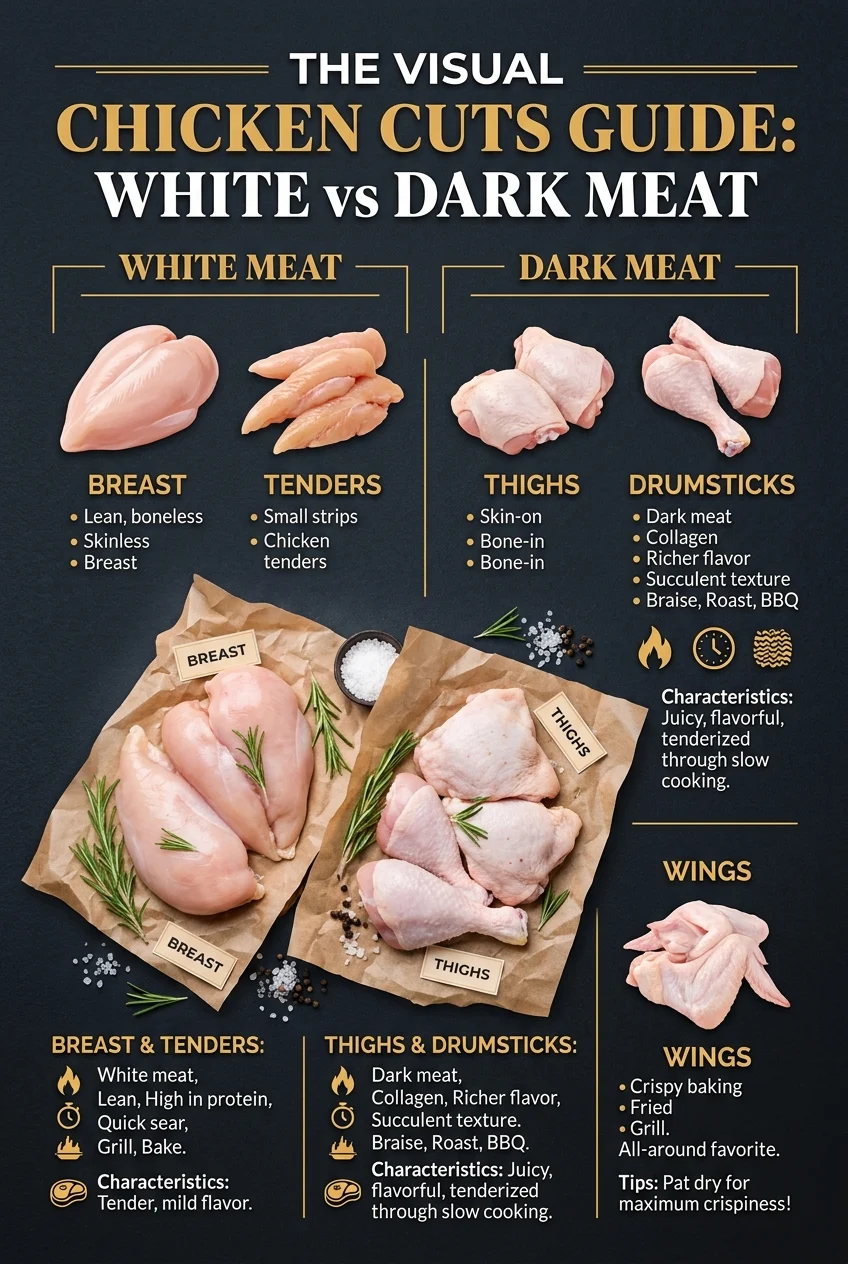
Tap image or button to save this guide to your Pinterest board
Chicken Breast — High Stakes, High Reward
Chicken breast is the most popular cut in home cooking and the most commonly ruined. Carry-over will bring it to 158–160°F — pasteurised, juicy, and safe.
The science: breast meat is almost entirely fast-twitch muscle fibres (pectoralis major) with very little intramuscular fat or collagen. When it hits 165°F+, the myosin proteins denature fully and squeeze out all retained moisture in under 30 seconds. There is no recovery from overcooked breast — the Maillard reaction on the surface cannot compensate for chalky, dry interior.
- Pound to even thickness (plus or minus 2mm) before cooking — eliminates the thin-end overcook problem
- Brine 30–60 minutes in 1 tbsp salt per cup water before any dry-heat method
- Bone-in breast: add 8–12 minutes cook time vs boneless; bone conducts heat and adds moisture buffer
- Never cook from frozen without fully thawing — ice crystal damage pre-stresses the muscle fibres
- Slice against the grain to shorten fibre length — makes even slightly overcooked breast feel more tender
Common breast mistakes: cooking at too low a heat (surface stays pale, interior overcooks before browning), not resting (juice runs immediately on cut), and buying the thickest breasts available (larger = older bird = tougher fibre structure).
Chicken Thigh
The reason is simple: thigh is engineered by nature to withstand sustained effort (walking muscle) and contains 3 to 4 times the intramuscular fat of breast, plus collagen that converts to gelatin between 160°F and 180°F.
Below 165°F, collagen has not fully converted and texture feels slightly chewy. Above 185°F in a dry-heat method, the fat begins to render too aggressively and the muscle tightens. In a braise or slow cooker, you can push past 195°F — the surrounding liquid prevents moisture loss.
Boneless vs bone-in thigh:
- Boneless skinless: 8–12 min total in a hot pan, best for stir-fry, tacos, meal prep
- Boneless skin-on: 12–15 min, best for pan searing with maximum crispy skin surface
- Bone-in skin-on: 35–45 min oven, develops the deepest flavour due to bone marrow compounds releasing during roasting
- Bone-in skinless: ideal for braises and curries — bone adds body to the sauce without the skin fat clouding it
They are forgiving to a degree that breast is not — overshooting by 10°F costs you nothing, undershooting by 5°F is still safe territory.
Drumstick — The Underrated Collagen Cut
Drumsticks are the highest collagen-density cut available in a standard chicken. The drumstick shank contains the gastrocnemius muscle — the most exercise-intensive muscle on the bird — surrounded by a dense collagen matrix.
At 165°F, drumstick meat is technically safe but texturally disappointing — rubbery, with the tendon structure still intact and meat clinging firmly to bone. The target is 180°F minimum, with 185°F being optimal for braise-adjacent methods.
- Braise in seasoned liquid (30–40 min covered) — highest rate, collagen converts fully
- High-heat oven (425°F / 220°C for 35–40 min) — good skin crispiness, adequate collagen conversion
- Deep-fry (325°F oil, 12–14 min) — excellent crust, reliable internal temp
- Slow cooker (6 hrs low) — tender but skin is not recoverable; finish under broiler 5 min
- Grilling — difficult to manage indirect/direct heat; frequent rotation required to avoid burning before reaching 180°F
Chicken Wing — The Temperature Outlier
Wings require the highest internal temperature of any cut — 190°F to 200°F (88–93°C) — and this is not a food safety requirement, it is a texture requirement.
Wing anatomy explains this: each wing is three sections (drumette, flat/wingette, tip), all with a very high skin-to-meat ratio. The subcutaneous fat layer must fully render to achieve crispiness — this happens above 180°F internal. At 165°F, wing meat is safe but the skin remains rubbery and the fat has not rendered.
Wing cooking by method:
- Deep-fry: 350°F oil, 10–12 min for room-temp wings; reaches 200°F naturally
- Air-fry: 400°F, 20–22 min, flip at 10 min; pat completely dry first
- Oven: 425°F on a rack, 40–45 min; baking powder trick (1 tsp per 2 lbs with salt) accelerates skin render
- Twice-fry: 300°F for 8 min, rest 5 min, 375°F for 4 min — the crispest texture
Tenderloin — The Speed Cut
The chicken tenderloin is the strip of meat beneath the breast, connected by the suspensory ligament. It is the most tender cut on the bird — lower in connective tissue than breast, smaller in fibre diameter — and cooks faster than any other part.
Because of their small size (40–70g each) and uniform thin shape, tenderloins cook in 3–4 minutes per side in a medium-hot pan. They are not suitable for high-heat searing (exterior burns before interior reaches temperature) or slow methods (they become cotton-dry). Best uses: stir-fry, poaching for salads, schnitzel-style breadcrumbing, and quick sautes.
The white tendon: tenderloins contain a white cartilaginous tendon running through the centre. Remove it before cooking by pinching the end and pulling while holding the meat against the board with a fork — it strips out cleanly. Leaving it in causes the tenderloin to curl and cook unevenly.
Whole Bird — The Technique Challenge
Roasting a whole chicken is the single most technically demanding chicken task in home cooking, because breast and thigh have different optimal pull temperatures (155°F vs 175°F respectively) and the breast always reaches target temperature before the thigh. This creates a fundamental engineering problem: by the time the thigh reads 175°F, the breast may have been at 155°F+ for 15 minutes and is now overdone.
- Spatchcock the bird — removes backbone, flattens the bird, breast and thigh cook 80% in parallel. Fastest whole-bird method. See How to Spatchcock Chicken.
- Stuff the cavity with aromatics — keeps the breast cavity temperature lower while exterior heats; buys 5–8 minutes of parallel cooking time
- Rotate the bird breast-side-down for the first half of cooking — positions the breast further from the oven floor heat source
- Rest tent method — when breast hits 145°F, tent loosely with foil; carry-over works on breast while thigh continues to climb on the resting board
Cut Selection by Recipe Type
| Recipe Type | Reason | |
|---|---|---|
| Stir-fry | Boneless thigh or tenderloin | High heat tolerance; cooks in 3–5 min |
| Curry / braise | Bone-in thigh or drumstick | Collagen enriches sauce; texture survives long cook |
| Grilling | Boneless skin-on thigh | Fat prevents flare-up drying; skin chars beautifully |
| Salads / meal prep | Poached breast or tenderloin | Lean, slices cleanly, low-fat |
| Fried chicken | Mixed pieces (breast + thigh + drum) | Full experience; varied texture in one batch |
| Roast dinner | Spatchcocked whole bird | Even cooking; maximum surface crispiness |
| Soup / stock | Whole bird carcass + backs | Maximum gelatin and mineral extraction |
Frequently Asked Questions — Chicken Cuts Guide
Is chicken thigh always better than breast?
For most cooking methods, yes. Thigh has higher fat content, more collagen, and a 20°F wider margin for error. The only contexts where breast outperforms thigh: poached salads (lower calorie, cleaner flavour), schnitzel-style dishes (even flat surface for breading), and recipes where a lean texture is specifically desired.
Why does my drumstick meat stick to the bone even after reaching 165°F?
Because 165°F is too low for drumsticks. At that temperature, the collagen surrounding the muscle fibres has not converted to gelatin. At 180°F, collagen conversion is complete, the meat naturally releases from the bone, and the connective tissue becomes the sauce-enriching gelatin that makes drumsticks satisfying rather than chewy.
What is the difference between chicken breast and chicken tenderloin?
The tenderloin is a separate muscle (the pectoralis minor) that runs beneath the main breast (pectoralis major). It is roughly half the size, has finer muscle fibres, cooks faster, and is slightly more tender by default. The white tendon running through it must be removed before cooking. Tenderloins are not interchangeable with breast strips — they cook 40% faster and become dry if treated identically.
Can I substitute drumsticks for thighs in a braise recipe?
Yes, with adjustments. Add 10–15 minutes of braising time (drumsticks need longer to hit 180°F vs thighs at 175°F), ensure liquid covers at least 70% of the drumstick, and expect a slightly more collagen-rich sauce due to the higher connective tissue content. The flavour result will be slightly more intense. Drumsticks are the better choice for braises where you want a thicker sauce from reduced braising liquid.
Why do wings need a higher temperature than thighs?
Because the goal with wings is different. Thighs target juiciness — collagen conversion at 175°F achieves that. Wings target crispy skin and cleanly rendered subcutaneous fat — that rendering is only complete at 190–200°F. Wing meat is not adversely affected at these higher temperatures because the very high skin-to-meat ratio keeps the small amount of meat from becoming dry.
What cut should I use for chicken skewers on a grill?
Breast cubes on skewers are the single highest-failure item in backyard grilling because they lose contact with the skewer as they contract and dry out before achieving colour. Thigh cubes remain moist through the grill time, maintain contact with the skewer, and caramelise beautifully due to their higher fat and sugar content. Thread them tightly, not loosely, to slow the edge cooking rate.