How to Season Chicken: Salt Ratios, Timing & Deep Flavor Science
Last updated September 27, 2026
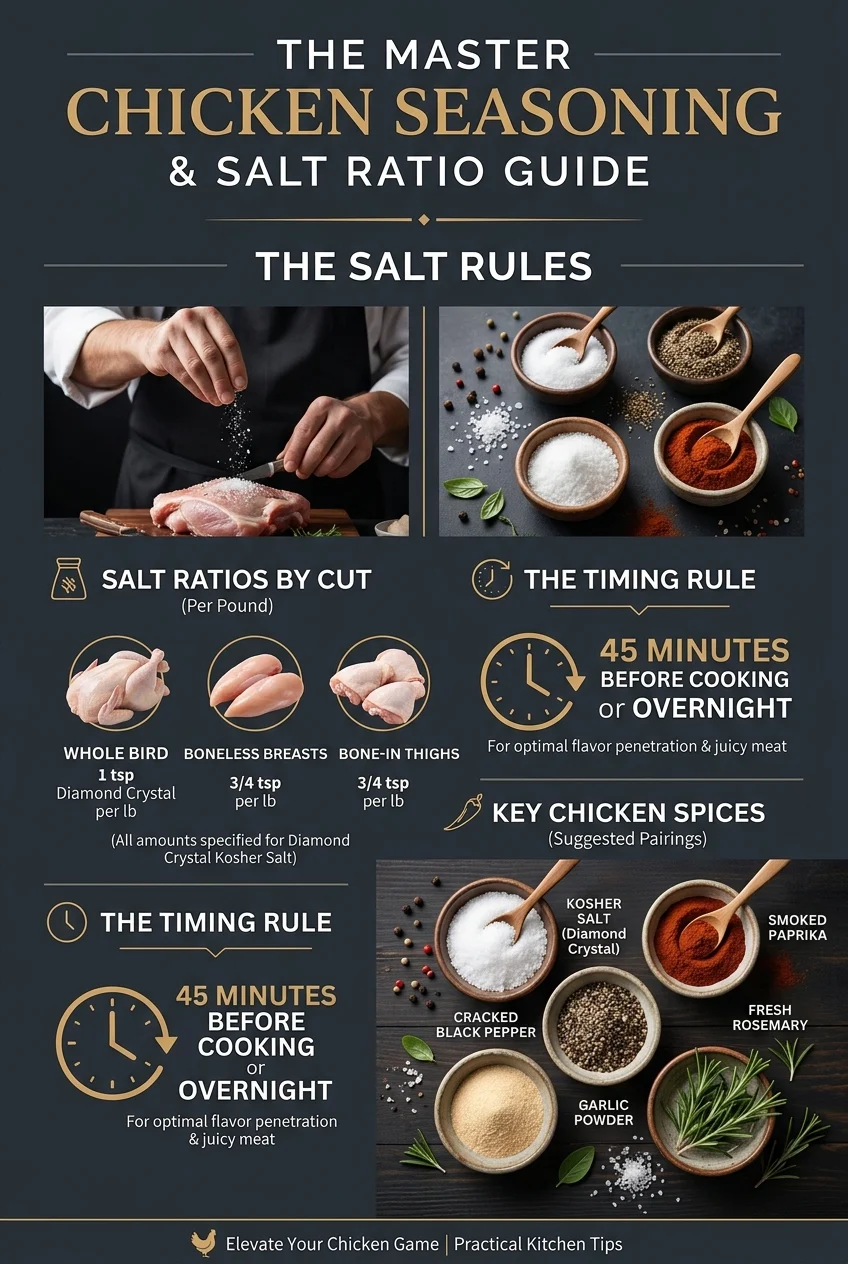
Season with salt at least 45 minutes before cooking or the night before. Never season immediately before cooking — surface moisture drawn out by salt has no time to reabsorb. Salt under the skin reaches the meat directly. Salt on the skin stays on the skin.
Most chicken is under-seasoned. Not because cooks use too little salt, but because they season at the wrong time and in the wrong place. Salt applied to the surface of chicken 5 minutes before cooking draws moisture out but has no time to pull it back in. The result is wet surface, compromised browning, and under-seasoned meat beneath a salty crust.
How Salt Penetrates Chicken
Salt penetrates chicken through osmosis. Applied to the surface, salt dissolves in the natural surface moisture of the meat and creates a concentration gradient — high salt outside, low salt inside. Water and dissolved salt then move inward through the meat’s moisture channels to equalise that gradient.
The rate of penetration: approximately 1cm of depth per hour under refrigeration. A 3cm-thick breast needs a minimum of 3 hours of salting to fully season the centre from one side, or 1.5 hours if salted on both sides. Salt applied to bone-in skin-on chicken needs additional time because the skin is a partial barrier.
Less than 45 minutes and the salt is still concentrated at the surface. More than 12 hours and the penetration is complete and even throughout.
Seasoning Timing
| Timing | Result | |
|---|---|---|
| Immediately before cooking (under 10 minutes) | Surface wet, salt not absorbed, compromised browning | Worst outcome |
| 30–45 minutes before cooking | Salt partially absorbed; better than immediate but surface still slightly moist | Minimum acceptable |
| 45 minutes to 4 hours | Surface has dried after initial moisture release; salt penetrating | Good |
| Overnight (8–24 hours) | Full penetration, surface dry, evenly seasoned throughout | |
| 48+ hours (dry brine) | Complete penetration, papery dry surface, excellent results | Best for roasted and grilled |
Tap image or button to save this guide to your Pinterest board
Where to Season: Skin, Under-Skin, and Cavity
On the skin: Salt on the skin seasons the skin only. It does not penetrate through skin into the meat in any meaningful way. Salt on skin is essential for browning, flavour of the skin itself, and carry-over from the skin to pan juices.
Under the skin: Salt applied directly between the skin and the meat seasons the meat directly. This is the most effective way to season the flesh of a whole bird or skin-on pieces. Carefully loosen the skin from the breast and thighs without tearing it, and work salt directly onto the meat surface.
In the cavity of a whole bird: The cavity is a large expanse of unseasoned meat surface. Salt the cavity walls directly. This is often skipped and results in the inner breast meat being bland even when the outside is well seasoned.
Seasoning boneless, skinless breasts: Salt both sides and allow to rest uncovered in the refrigerator. With no skin barrier, penetration is faster. 1–2 hours is sufficient for a standard-thickness breast.
How Much Salt
- Chicken breast, boneless: ½ teaspoon fine sea salt per 200g breast
- Skin-on pieces: ¾ teaspoon kosher salt per piece
- Whole bird: ¾ teaspoon kosher salt per 500g total weight
These are not minimums. These are calibrated amounts. More than this and you push toward over-salted territory, especially with longer rest times where penetration is more complete. Less and the meat is underseasoned at the centre.
Black Pepper — When to Add It
Black pepper belongs at two points: before cooking (for depth, where the heat blooms the volatile aromatics) and after cooking (for brightness, where fresh pepper adds a sharp top note).
Pre-cooking pepper on skin-on chicken: apply with the salt to the skin surface. High heat will toast the pepper, adding complexity. Under-skin pepper is wasted — it does not bloom in the absence of fat contact.
Beyond Salt: Layering Seasoning
Salt is the foundation. Everything else is modulation.
- Smoked paprika adds colour, smoke, and a mild sweetness. Excellent on skin that will be roasted or grilled. Apply with salt, overnight.
- Garlic powder (not garlic salt) penetrates with the salt. Fresh garlic on the surface burns above 160°C before the chicken is cooked. Garlic powder handles heat more gracefully.
- Dried herbs (thyme, oregano, rosemary) applied with salt develop complex aromatic notes over the rest period. Fresh herbs are better added during cooking or finishing.
- Citrus zest adds brightness but the volatile oils degrade over extended rest. Add 30–60 minutes before cooking, not overnight.
- Cayenne or chilli behaves similarly to other dried spices. Penetrates with salt over time. Can be added overnight.
The Marinade Question
Marinades are often presented as a seasoning solution, but their penetration depth is limited. Most marinade penetrates only 2–3mm into the surface, regardless of how long you marinate. What marinades do well: flavour the surface, tenderise the outer protein layer (acidic marinades), and add colour during cooking.
The salt in a marinade does penetrate over time, so overnight marination in a salt-containing marinade does achieve some of the benefit of dry brining. But marinade without adequate salt is surface decoration, not seasoning.
FAQ: How to Season Chicken
When should you season chicken before cooking?
Seasoning immediately before cooking (under 10 minutes) is worse than not seasoning at all — it draws surface moisture out without time for reabsorption, leading to wet surfaces and poor browning.
Should you season chicken under the skin?
Yes, always. Salt on the skin seasons the skin only. Salt under the skin (between skin and meat) reaches the meat directly and produces evenly seasoned flesh even when skin is removed before eating.
How much salt do you put on chicken?
These amounts are calibrated for overnight seasoning — shorter rest times may need slightly more.
Does marinating chicken season it properly?
Marinades season the surface (2–3mm penetration) and add flavour and colour. They do not substitute for proper salt penetration. The salt content of the marinade does penetrate over longer marination times (8–24 hours). For full interior seasoning, salt the chicken separately and allow adequate rest time.
Can you over-season chicken with salt?
Yes. The longer the rest, the more penetration occurs. Scale down salt amount if resting longer than 24 hours.
Seasoning Ratios & Timing Master Table
Tested Recipes That Put This Seasoning Standard to Work
Here are five Chickeeen Test Kitchen recipes where precise seasoning timing and placement make the definitive difference:
- Best Lemon Herb Roast Chicken Recipe — Uses lemon zest with kosher salt rather than acidic lemon juice so the skin renders crisp while seasoning the meat deeply.
- Best Chicken Shawarma Recipe — A 12-hour spiced yogurt marinade where thigh fat acts as the carrier molecule for cumin, coriander, and garlic.
- Best Chicken Piccata Recipe — Thinly pounded cutlets salted 30 minutes before lightly dredging in flour, ensuring pan juices and lemon-caper butter integrate seamlessly.
- Best Crispy Fried Chicken Recipe — Double-seasoned: salted in the buttermilk soak and reinforced in the seasoned flour dredge.
- Best Chicken Parmesan Recipe — Salted cutlets maintain moisture under the crunch of golden breadcrumbs and bubbling melted mozzarella.